


Best Bank Stocks for May 2026: JPMorgan, Goldman & the Q1 Earnings Trade
- Will Bell

- Mar 30
- 9 min read
Updated: May 1
Every May, one group of stocks fires the starting gun for the entire earnings season. It's always the banks.
`And this May, the setup is one of the most compelling in years.
🤔 Think about what May means on Wall Street.

It's the month the curtain gets pulled back.
Companies stop forecasting and start reporting.
And the traders who spent March positioning themselves?
They're about to find out if they were right so here are some of the best bank stocks for May 2026.
You see the Bank stocks go first.
Always.
👉 JPMorgan Chase typically reports in the second week of April. Goldman Sachs follows.
Then Morgan Stanley, Bank of America, Citigroup, and Wells Fargo - all within the same 5-day window.
That first week of bank earnings sets the tone for every other sector that follows. If the banks beat - the whole market rallies.
😱 If they miss - brace yourself.
Here's what makes May 2026 especially interesting:
• Goldman Sachs reports Q1 2026 earnings on April 13 - confirmed date, before market open.
• Goldman's investment banking backlog just hit its highest level in four years - and it's still growing.
• JPMorgan posted adjusted Q4 EPS of $5.23, beating the $5.00 consensus - and guided full-year 2026 net interest income at $103 billion.
• The Finance sector as a whole is projected to deliver +19% earnings growth in Q1 2026 - second strongest of any S&P 500 sector.
• M&A activity is accelerating under the current administration, with CEOs seeing a rare window for large deal approvals.
The banks are primed. 💵
👉 The question is which ones are smart traeders aiming to own - and why - before the reports hit.
Here's the complete breakdown.
JPMorgan Chase (JPM) - The Bank That Runs Wall Street
You want to understand the health of the American economy?

Don't read the Fed minutes.
Watch JPMorgan's earnings call.
Jamie Dimon runs the largest bank in the United States by assets.
When he speaks during earnings - every trader, every analyst, every portfolio manager stops what they're doing and listens.
His commentary on credit quality, consumer spending, M&A pipelines, and interest rate expectations moves markets more than almost any other single earnings call of the year.
Here's what we already know heading into Q1 2026:
Q4 2025 Adjusted EPS | $5.23 (Beat $5.00 Consensus) |
Q4 2025 Revenue | $46.77B (Beat $46.2B Estimate) |
Full-Year 2026 NII Guidance | ~$103 Billion |
Markets Division Q4 Revenue | $8.2B — Up 17% YoY |
Q4 Equities Trading Revenue | Up 40% — AI-Driven Volatility |
JPMorgan's markets division absolutely crushed it in Q4 2025, with equities trading revenue surging 40% driven by what management called 'AI-driven volatility.'
👉 That tailwind doesn't disappear in Q1 2026 - if anything, it intensifies as geopolitical tensions and tariff uncertainty keep markets churning.
The M&A story is equally compelling. During the Q4 earnings call, Dimon explicitly said the pipeline for mergers and acquisitions is at multi-year highs.
Several massive deals that were set to close in December got pushed into Q1 and Q2 2026.
That's deferred revenue - already in the pipeline - waiting to hit the income statement.
📅 Watch for: JPMorgan Q1 2026 earnings - typically reported second week of April. Dimon's guidance language will move the entire banking sector.
The bottom line: JPMorgan is the bellwether.
If you own one bank stock heading into May earnings season, this is it.
The combination of dominant trading revenue, record M&A backlog, and $103 billion NII guidance makes it the most important financial stock to watch in May 2026.

👉 Want real-time alerts when big-cap setups like JPM are forming?
Goldman Sachs (GS) — The Pure Play on Wall Street's Deal Machine
If JPMorgan is the bank for everyone, Goldman Sachs is the bank for Wall Street.

Goldman doesn't have thousands of retail branches.
It doesn't issue credit cards to average Americans.
💵 It does one thing better than almost any institution on the planet: it makes money when deals get done, markets move, and money flows.
And right now? All three are happening at once.
Q1 2026 Earnings Report Date | April 13, 2026 (Confirmed — Before Open) |
Q1 2026 EPS Forecast | $15.92 (Analyst Consensus) |
Full-Year 2026 EPS Growth Forecast | +12.6% to $55.15 |
Investment Banking Backlog | Highest in 4 Years — Still Growing |
Q4 2025 EPS | $14.01 — Beat $11.52 Estimate by 21% |
52-Week Stock Performance | +61.3% — vs S&P 500's +16.5% |
That Q4 EPS beat was extraordinary. Analysts expected $11.52. Goldman delivered $14.01.
That's a 21% beat - the kind of number that makes traders immediately ask: 'What does Q1 look like?'
The answer, based on everything Goldman's management has signaled, is even better.
Goldman's CEO David Solomon has been unusually bullish heading into 2026.
He pointed specifically to CEO confidence in deal-making under the current regulatory environment as a major tailwind.
The Global Banking and Markets segment - Goldman's engine - accounts for over 77% of total revenue.
In Q4 2025, that segment saw revenue rise 22%, with investment banking fees and net equity revenues both up 25%.
That momentum is carrying directly into Q1 2026.
👉 Goldman also made a strategically smart exit from consumer lending - selling the Apple Card business to JPMorgan.
Goldman lost roughly $7 billion in consumer lending since 2020.
That chapter is closed.
Now the focus returns entirely to what Goldman does best: institutional banking, trading, and wealth management.
📅 Goldman Sachs Q1 2026 Earnings: April 13, 2026 - Before Market Open. This is the most watched bank earnings report of April.
The bottom line: Goldman goes into April earnings with a four-year high backlog, a cleaned-up balance sheet, accelerating M&A activity, and management that just beat estimates by 21% last quarter.
The April report is a major catalyst - position before it, not after.
Morgan Stanley (MS) - Wealth Management Meets Investment Banking
Morgan Stanley doesn't get talked about as much as JPMorgan or Goldman.

That's exactly why it's worth paying attention to.
💵While Goldman is pure Wall Street and JPMorgan is the everything-bank, Morgan Stanley has quietly built one of the most profitable wealth management businesses in the world - a division that generates steady, recurring revenue regardless of what the trading floor is doing on any given day.
That combination - cyclical investment banking upside plus defensive wealth management income makes Morgan Stanley one of the most balanced financial -stocks you can own heading into a volatile market.
Q1 2026 Report Date | Mid-2026 |
Expected Q4 M&A Advisory Fees | Above Market Consensus |
Expected Q4 Equities Revenue | Above Market Consensus |
Investment Banking Ranking | Top 5 Globally — IBD & Equities |
2026 Strategy | Broadening market = MS wealth management upside |
Ahead of Q4 2025 earnings, Morgan Stanley itself projected that M&A advisory fees, markets revenue, and equity trading revenue would all exceed growth expectations.
When a bank pre-signals a beat, it's usually because they're very confident in what they're about to report.
The broader market is also working in Morgan Stanley's favor.
Goldman Sachs Research expects the 2026 bull market to broaden beyond mega-cap tech - with small caps and mid-caps starting to participate more meaningfully.
👉 The bottom line: Morgan Stanley is the steady professional in a room full of high-energy traders.
It won't give you the most explosive upside - but it gives you M&A exposure, trading upside, AND wealth management stability in one stock.
Bank of America (BAC) — The Rate Play With 1.9 Trillion Reasons to Watch
Here's a number worth sitting with for a moment.

Bank of America holds $1.9 trillion in total deposit balances - up 2.4% annually.
👉 That's not just a balance sheet figure.
That's the foundation for one of the most interest-rate-sensitive earnings stories in the entire financial sector.
When rates eventually come down - and Goldman Sachs Research is forecasting 50 basis points of Fed cuts in 2026 - BofA's net interest income faces pressure.
That's the tension traders are watching heading into May earnings.
💵 But here's the other side of that story: lower rates mean more refinancing activity, more corporate borrowing, and more dealmaking.
BofA benefits from all three through its investment banking arm - ranked in the top 4 globally alongside JPMorgan, Goldman, and Citi.
Total Deposit Balances | $1.9 Trillion (Up 2.4% YoY) |
Q3 2025 EPS | $0.81 — Beat Estimates |
Q3 Underwriting Income | Up 24.5% YoY |
Q3 Sales & Trading Revenue | Up 11.7% YoY |
Analyst Consensus Rating | Moderate Buy — 13 Strong Buy, 3 Moderate Buy |
Average Analyst Price Target | $48.65 |
The key catalyst to watch in May: BofA's guidance on net interest income for the rest of 2026.
🔥 If management signals that NII is holding up well despite rate cut expectations - the stock could move sharply higher.
If the guidance disappoints, expect the opposite.
The bottom line: Bank of America is a high-stakes read on the interest rate environment. With $1.9 trillion in deposits and a top-tier investment banking operation, the April earnings report will tell you everything you need to know about how BofA - and the broader rate trade - sets up for the second half of 2026.
Citigroup (C) — The Global Bank Trading at a Discount
Citigroup is the most international of the major U.S. banks - and right now, that's a significant edge.
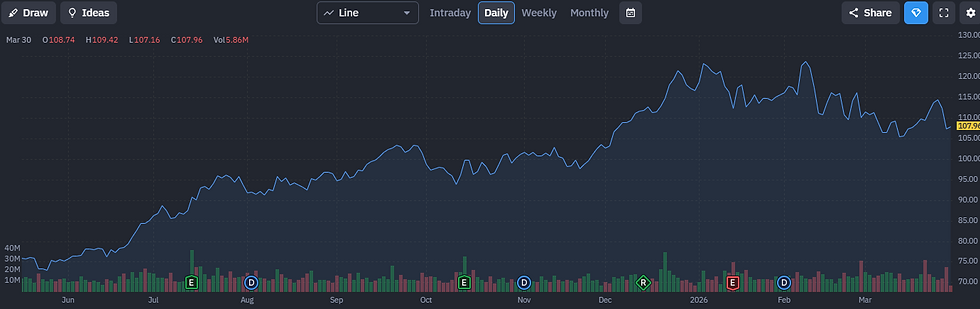
While JPMorgan and Goldman are dominating domestic deal flow, Citigroup has one of the deepest global banking footprints of any American institution.
With Goldman Sachs Research forecasting global GDP growth of 2.8% in 2026 - above the 2.5% consensus - that international exposure is a meaningful differentiator.
Heading into Q4 2025 earnings, Citigroup led all Global Systemically Important Banks (GSIBs) in expected year-over-year earnings growth at +21%.
That's the fastest growth rate of any major bank - and the stock was trading at one of the cheapest valuations in the sector.
👉 CEO Jane Fraser has spent the last two years executing one of the most ambitious restructuring programs in banking history - simplifying the business, cutting costs, and focusing Citigroup on its core strengths in institutional banking, markets, and global payments. Q1 2026 earnings will show whether that transformation is delivering results.
Q4 2025 Expected YoY EPS Growth | +21% — Highest Among Major U.S. Banks |
2026 GDP Growth Forecast (Goldman) | 2.8% Global — Above 2.5% Consensus |
Business Focus | Global Institutional Banking + Markets + Payments |
Valuation vs Peers | Trading at a Discount — Restructuring Discount Fading |
CEO Restructuring Program | Ongoing — Simplification Driving Margin Expansion |
The bottom line: Citigroup is the value play in the bank sector.
Fastest projected earnings growth, global exposure, restructuring tailwind, and a cheap valuation.
When the discount closes - and the Q1 earnings report could be the catalyst - the move can be fast.
How Smart Traders are Trading the May Bank Earnings Season
Five banks. 🏦
Five different stories.
One overriding theme:

May earnings season is the single best opportunity all quarter to trade the financial sector - but only if you know what to watch for.
What to Watch in Every Bank Report
• Net Interest Income (NII) guidance - this tells you how rate cuts will affect profits for the rest of the year
• Investment banking revenue - is the M&A backlog converting into actual fees?
• Trading revenue - equities and FICC desks either crushed it or didn't
• Credit quality - charge-off rates above 3.4% (JPMorgan's guidance) signal consumer stress
• Management tone - Jamie Dimon's exact words about the economy move markets. Listen carefully.
📈 The Trading Rule That Protects You

Bank stocks can gap up or down 4-6% on earnings. That's not a slow drift — that's a violent overnight move.
If you're holding through the report, size your position for the risk.
⚠️ A full position into a binary earnings event is speculation, not trading.
The traders who get hurt in earnings season aren't the ones who missed the move.
They're the ones who held too large through the report and got caught on the wrong side of a guidance miss.
Goldman Sachs reports April 13. That's your first major marker. Watch the reaction. The rest of bank earnings follows within 72 hours.
➡️ Get professional-grade big-cap alerts before the next earnings move. Join GPSM Next Big Cap Alerts →
May 2026 Bank Stock Watchlist: Quick Reference
• JPM (JPMorgan Chase) - Bellwether of earnings season. $103B NII guidance, record M&A pipeline, 40% equities trading surge in Q4.
• GS (Goldman Sachs) - Reports April 13. Q1 EPS forecast $15.92. 4-year high IB backlog. 21% Q4 earnings beat. Pure Wall Street deal machine.
• MS (Morgan Stanley) - Wealth management + investment banking. Pre-signaled Q4 beat. Broadening market is a tailwind.
• BAC (Bank of America) - $1.9T deposits. Rate sensitivity = high-stakes NII guidance. Top 4 global investment bank.
• C (Citigroup) - Fastest projected EPS growth (+21%) among major banks. Global exposure. Restructuring discount fading.
The Final Word on Bank Stocks
🍪The banks don't just report earnings in April
They set the narrative for the entire market for the next three months.
When JPMorgan beats and Dimon sounds confident - risk-on. When Goldman's M&A fees disappoint - risk-off.
When BofA guides NII lower than expected - rate trade recalibrates. Everything flows from that first week of bank earnings.
The traders who win in May aren't the ones reacting fastest to the headline numbers.
They're the ones who understood the setup before it happened - knew which stocks to watch, knew what metrics mattered, and knew exactly where they'd get in and where they'd get out.
That's what separates professionals from the crowd.
👉 Want to trade the next big financial sector move with professional-grade alerts?
➡️ GPSM Next Big Cap Alerts delivers real-time setups directly to you - before the crowd catches on.


Comments